From Borrowed Tables to a Shared Tool Library
A shared tool library can turn borrowed tables and neighbor-owned gear into a dependable community resource through clear stewardship and return routines.
When folding tables appear in a neighbor’s garage before a block gathering, they solve one immediate problem: where to set the food. After the event, though, someone has to remember whose tables they are, where they belong, and whether they can be borrowed again. A shared tool library begins with that small handoff. It turns separate offers of useful objects into a community resource by making care and return part of the project, not an afterthought.
What changes when borrowing becomes a shared resource?
A borrowed object usually has a clear owner and a one-time favor attached. A shared resource has a continuing purpose: neighbors can use it, and a group accepts responsibility for keeping it available and in usable condition. The difference is not a large collection or a formal organization. It is an agreed way to handle access, care, and return.
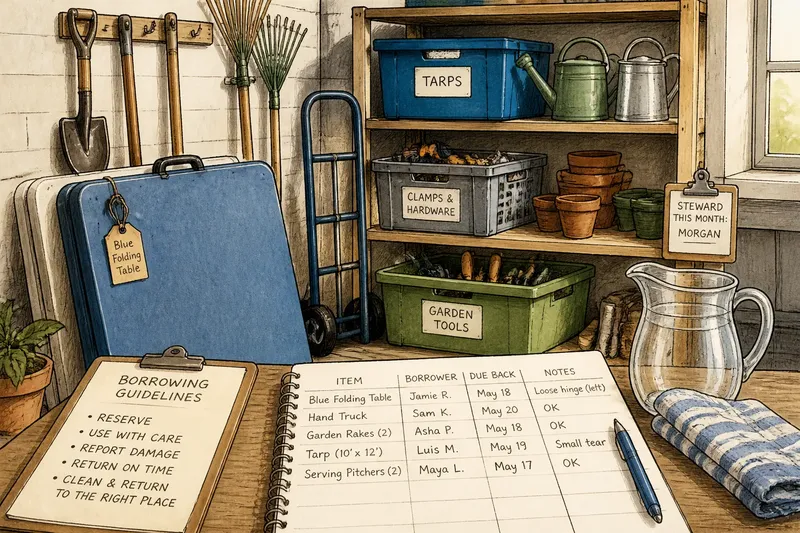
Start with objects people already lend or repeatedly need. Folding tables, hand trucks, garden rakes, tarps, and serving pitchers may all work, but a collection should reflect local use rather than an abstract idea of what a library ought to contain. A few well-chosen items with reliable routines are more useful than a crowded pile nobody knows how to borrow.
This shift also changes the meaning of a contribution. Someone who lends a table is not simply giving the group permission to use it once. They are helping establish a resource whose future use depends on everyone treating the item as shared property, even when it still belongs to a particular person. That distinction should be explicit from the beginning.
Which objects belong in the first collection?
Choose items that solve a recurring local need and can be stored, identified, and returned without unusual effort. Ask people who organize garden workdays, street cleanups, community meals, or neighborhood events what they often scramble to find. Their answers reveal practical gaps: a cart for moving supplies, clamps for a temporary display, or a sturdy watering can for a shared planting area.
For each proposed item, consider its condition, storage needs, and the care it requires. A set of chairs may be easy to lend but awkward to store. A power tool may be useful but call for training, protective equipment, or careful limits on who may use it. For a small first collection, simple objects with visible condition and straightforward handling are often easier to steward.
Be clear about ownership. An item might be donated to the group, lent by a neighbor for an agreed period, or purchased with shared funds. Those arrangements are not interchangeable. The group should know who can make decisions about repair, replacement, or removal, and the contributor should know what happens if the project changes or the item is no longer needed.
How can the group make borrowing understandable?
A borrowing routine should answer a few ordinary questions without making each request feel like a negotiation. Who may borrow? Where is the item kept? How does someone reserve it? What condition should it be in when it comes back? A paper sign-out sheet, a shared calendar, or a simple notebook can all work. Choose the least complicated method the people involved will actually maintain.
Give each object a recognizable name and a place in the record. “Blue folding table” is easier to identify than “table three” if nobody remembers the numbering. Note who has it, when it is expected back, and any existing issue that matters, such as a loose hinge. If a borrower cannot access the record or storage location, the process is not yet clear enough.
Imagine a neighborhood group that owns two folding tables and keeps them in a community room. A volunteer asks to use one for a courtyard gathering. The group writes the borrower’s name and expected return day in a notebook beside the storage shelf, then agrees that the table will come back folded and wiped down. When it returns, the next person can see that it is available and ready to use. The observable result is a completed handoff, not a new round of guesswork.
Set expectations without turning the system into a contract-heavy barrier. A brief note can explain that borrowers should report damage promptly and return items to their assigned place. If the group handles higher-risk equipment, access rules need more care; labels, manufacturer instructions, and local rules may determine what is appropriate, and a qualified professional may be needed for safety questions.
Who looks after the objects between loans?
Stewardship is the quiet work that keeps a shared collection credible. It includes checking that items are present, noticing wear, updating the borrowing record, and deciding when something needs attention. The work can rotate among volunteers, but the responsibility should be visible. If everyone assumes someone else is watching, small issues tend to become surprises.
Assign a steward or a small rotating team for a defined period. Their role is not to personally repair everything or approve every request. It is to keep the system legible: record changes, make sure return locations remain usable, and bring decisions to the group when an item needs repair, replacement, or retirement. A note on the storage door can identify the current contact without making that person a permanent gatekeeper.
Keep care proportional to the object. A table may need only a quick visual check and a wipe. A garden tool may need cleaning and a dry storage place. Do not create elaborate maintenance logs for objects that need little attention; record the information that helps the next borrower use and return each item responsibly.
It is also useful to make a distinction between ordinary wear and a problem that needs a decision. A scuffed surface may not affect use, while a damaged leg could make a table unsuitable. Agree who can pause borrowing when an item seems unsafe and how the group will decide what to do next. Avoid improvising repairs on equipment that calls for specialist knowledge.
What makes returns reliable without making borrowing awkward?
Return routines work best when they fit the way people use the collection. If a tool is borrowed for a weekend project, an expected return day may be enough. If tables circulate around event dates, a reservation calendar may help prevent overlapping plans. The aim is to make availability visible and to give borrowers a reasonable way to communicate a delay.
Make the return location specific. “Put it back in the community room” may leave a cart blocking the doorway or a rake outside in the rain. A labeled shelf, marked corner, or designated storage bin gives the handoff a clear endpoint. If an item is too large or heavy for the usual storage spot, say where it belongs and who can help arrange its return.
Build in a simple way to handle exceptions. A borrower might discover a missing part, a late return, or a change of plans. A contact name and a short message option let them report the issue before someone else arrives expecting the item. The group can then update the record and offer an alternative, if one exists, instead of treating silence as a personal slight.
What is not worth the effort? Requiring elaborate applications, signatures, and approval meetings for every low-risk object can make a useful resource feel inaccessible. Reserve extra formality for situations that genuinely call for it, and keep everyday borrowing as direct as the group’s needs allow.
How does the collection stay useful as the group changes?
A shared tool library is not finished once items have labels and a shelf. People move, volunteer roles shift, and the objects that matter can change. Keep the collection open to adjustment by asking periodically which items are being used, which are difficult to return, and which local needs have gone unmet. This need not become a formal survey; a short conversation at a project meeting can surface practical changes.
Use what people can observe. If a hand truck is repeatedly requested but absent from the shelf, the group may need a different reservation routine or another unit. If a set of serving bowls remains unused while neighbors borrow tables often, the next contribution might be better directed elsewhere. These observations help the group make decisions without pretending that every item will suit everyone.
Give contributors a clear route to step back. A neighbor who lent an object temporarily should be able to ask for it back under the terms agreed at the start. A donated item may need a different process if the group dissolves or changes its purpose. Talk through those possibilities before they arise, and record the decision in plain language so future stewards do not have to guess.
What questions come up as a tool library takes shape?
Does a shared tool library need a dedicated building?
No. A labeled cabinet, a corner of a community room, or a partner organization’s storage area may be enough for a modest collection. The location should be accessible to borrowers and practical for the people responsible for keeping it organized.
Should people pay to borrow items?
That depends on the group’s purpose and costs. Some collections rely on free lending, while others may ask for voluntary contributions or use shared funds for upkeep; make the arrangement clear before people borrow. If money is collected, someone should be responsible for tracking it and explaining how it is used.
What if an item is returned damaged?
Record what happened and pause further borrowing if the item may be unsafe or unusable. The group can then decide whether the damage is ordinary wear, a repair issue, or a reason to retire the object, while following the item’s instructions and seeking qualified help where needed.
How should a group begin if neighbors own different kinds of tools?
Ask people to offer only items they are comfortable making available, and write down whether each is donated or lent temporarily. Start with a small set of clearly identified objects, then adjust the borrowing routine as people learn what is easy to share and return.
What is the smallest useful next move?
Choose one recurring need and one object that can meet it. Ask its owner what sharing arrangement feels comfortable, identify a place to keep it, and write down a simple borrowing and return routine. Then invite a few neighbors to use that routine and point out where it is confusing.
That modest start is often enough to make the idea tangible. A folding table can lead to a cart, a rake, or a set of garden gloves, but the collection grows only as fast as the group can care for it. A shared tool library earns trust through the ordinary details: people know what is available, know how to borrow it, and can return it without leaving the next person a puzzle.