A Quiet Way to Join a First-Time Group Project
A first-time group project feels easier when you can observe, choose one bounded task, and agree on a handoff before deciding whether to return.
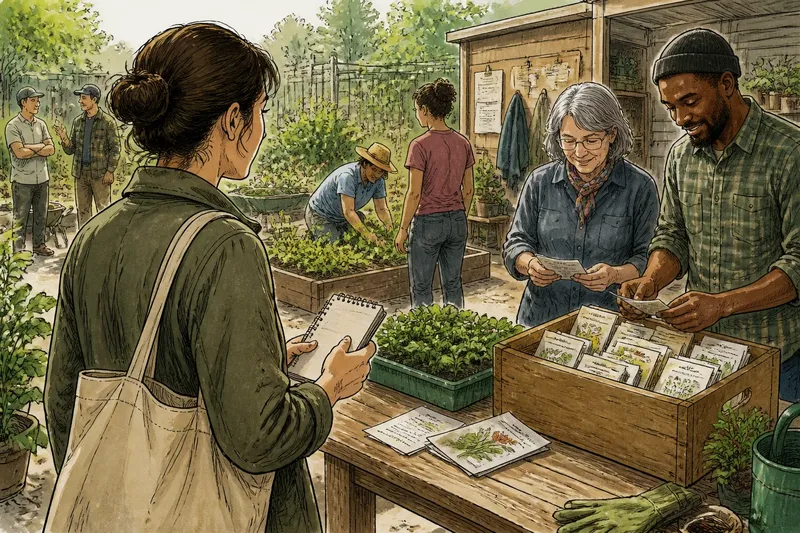
You arrive at the community garden while a few neighbors are sorting seed packets, and nobody seems to need another person right away. A first-time group project can feel less daunting if you treat your first visit as a chance to observe, make one bounded contribution, and agree how to hand it off—not as a promise to become a regular.
That approach gives you room to learn how the group works before you take on more. It also helps the people already there: a clear, limited task is easier to welcome than a vague offer to “help with anything.” You can choose a level of participation that fits your energy, schedule, and comfort with unfamiliar people.
Which first-visit approach fits you?
Most first visits fall into one of three useful approaches. They are not ranks or stages; choose the one that suits the day you are having.
- Observe first: Watch the task and ask a few practical questions before joining in. This suits you if the project is unfamiliar, busy, or hard to read from the outside.
- Take one bounded task: Choose a small piece with a clear finish, such as labeling a tray of seedlings or sorting a box of donated books. This suits you if you want to contribute but cannot promise to stay long.
- Join a paired task: Work alongside a volunteer who can explain the routine as you go. This suits you if you learn by doing or would rather not make decisions alone.
There is no need to pick the most active option to prove you belong. A short visit spent learning names, noticing how materials are shared, and understanding what happens next can be a useful contribution to your own decision.
What should you notice before choosing a task?
Give yourself a few minutes to watch the project as it actually works. Notice where people get instructions, which materials are ready to use, and how volunteers signal that they have finished. If someone is coordinating the work, look for a natural pause to introduce yourself rather than interrupting a concentrated task.
Ask one direct question: “What would be useful for someone joining for the first time?” Then listen for a task with a visible beginning and end. “Help with the garden” is broad; “fill these labeled pots and leave them on this table” is much easier to understand. If the answer is unclear, it is reasonable to ask who will show you what to do or where finished work belongs.
Pay attention to the social setup, too. A project may be friendly but still assume that people know its routines. Check whether new volunteers are expected to bring supplies, sign in, or coordinate with a particular person. The group’s ordinary instructions are usually more helpful than guessing from what other people are doing.
How do you choose a contribution with a clear edge?
A bounded contribution has a defined task, a reasonable stopping point, and somewhere for the result to go. It lets you participate without quietly inheriting responsibility for the entire project. Before starting, agree on three things:
- The task: What exactly are you doing?
- The stopping point: What will count as finished, or when do you need to stop?
- The handoff: Who should receive the work, materials, or update?
Say you visit a neighborhood cleanup and have time to sort a crate of reusable gloves. You ask the coordinator which pairs should be kept, sort them into the marked bins, and agree to leave the full crate beside the supply table when you are done. The result is visible, the group can use it, and you have not implied that you will manage future supplies.
If the task grows as you work, pause before accepting the extra piece. You can say, “I can finish this stack today, but I can’t take on the rest. Who should I leave it with?” That is not a rejection of the group; it is useful information for whoever is coordinating the work.
How should you hand off what you did?
A handoff prevents a finished task from becoming a mystery. Tell the coordinator what you completed, where you left it, and whether anything remains. If you sorted materials, for example, mention any items you could not classify rather than putting them somewhere and hoping someone notices.
Keep the update brief and specific. “The clean jars are on the back table, and these few need someone to check the labels” gives the next person a clear starting point. If the project uses a sign-in sheet, shared notebook, or group message, use the channel its organizers already rely on. There is no need to create a new system for a small contribution.
When you leave, you can also ask what happens next without agreeing to take part. A simple “Who picks this up from here?” helps you understand how the work continues. If you want to return, ask when newcomers are welcome or whom to contact. If you are unsure, say you would like to think it over.
Which questions help you decide whether to return?
What if the group seems too busy to explain the task?
Ask whether there is a better time to come back or a simple task you can do without close guidance. If neither is available, observing briefly and leaving politely is a reasonable first visit.
Can I leave before the project is finished?
Yes, if you set that limit up front and hand over any unfinished work. Tell the coordinator when you need to go so the group can adjust the task or find someone to continue it.
What if I am not ready to share my contact details?
You can ask whether the group posts its public meeting times or announcements somewhere you can check. You do not need to give personal information simply to make one visit.
How do I know whether to volunteer again?
Notice whether the task was clear, whether your limits were respected, and whether you felt comfortable asking questions. Those observations can guide your choice without requiring you to decide on the spot.
What is not worth the effort on a first visit?
Do not spend your first afternoon trying to learn every person’s role, solve the project’s larger problems, or prove that you are committed. Those efforts can blur the simple question you came to answer: does this way of participating suit you? A short, well-handed-off task is more useful than taking on extra work you may not be able to finish.
A first-time group project works best as an invitation, not an audition. Choose observation, one bounded contribution, or a paired task; then make the handoff clear. That small decision gives you a grounded way to decide whether to return, and it leaves the group knowing exactly what you did and what comes next.